


White Rust, A Bowed Bundle And Four Photos: How To Inspect Galvanized Square Tube The Day It Arrives
Oct 19, 2026
In June a buyer in Jebel Ali opened his container on a Thursday morning and sent me fourteen photographs before lunch. By the afternoon we had agreed on a credit for nine tubes. Last year another customer opened the same kind of container, stacked the tube in his yard, cut it into legs, welded the legs into racks, and wrote to me five weeks later to say the galvanizing was no good. There was nothing I could do for him. Not because I did not believe him, but because by then nobody could tell what had happened to that steel between our loading bay and his saw.
The gap between those two men was not the quality of the tube. It was about twenty minutes of work on the day the doors came open. I have written this down so that the next buyer does those twenty minutes, because a claim that arrives with the right photos is a claim I can settle, and a claim that arrives as a paragraph of complaint is a long argument neither of us enjoys.
Before you unload anything
Walk into the container first, with a torch, before the forklift starts. Look at the roof for condensation drips, at the floor for standing water, and at the condition of any desiccant bags you asked us to add. Photograph the door seal and the container number while the doors are still shut. That single picture settles arguments about whether the moisture got in during transit or in your yard afterwards.
Then compare the bundle count and the bundle tags against the packing list, and look at the bottom layer before it is buried under the rest. Damage in transit almost always shows up at the bottom of the stack or against the container wall, where a bundle has shifted against the corrugation for three weeks. A scuffed top bundle is usually nothing. A bottom bundle with flattened corners tells you something moved hard.
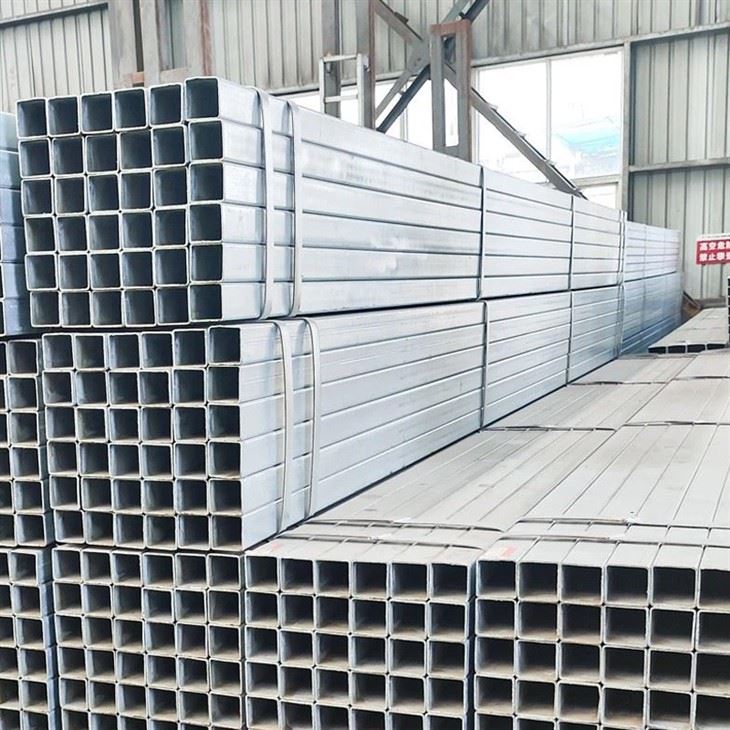
White rust is not the same as red rust
This is where most of my awkward emails come from. White rust is zinc hydroxide, and it forms when moisture sits between two galvanized surfaces with no air moving. You see it as a pale, chalky film, sometimes patchy, sometimes a whole face. It is a storage problem far more often than a coating problem, and here is the useful part: light white film wipes off with a dry cloth and leaves sound zinc underneath. Take a cloth to one tube and look at what is left.
Red rust is different. If you can see brown, the zinc is gone at that spot, and the question turns to how much of the surface is affected and whether it is scattered or concentrated. On a bundle of forty tubes, three small rust spots near a strap are one conversation. Rust running along a whole face on every tube in the bundle is another, and I would want to see it on the day of arrival, not in month two.
What you should not do is hose the bundle down and cover it with a tarp. That is the fastest way to turn a faint white film into a real problem, because the tarp holds the moisture in and the sun heats it. Ventilated storage, dunnage under the bottom bundle, and air moving between the layers is all the protection galvanized tube needs.
Checking the zinc without a laboratory
Most buyers who ask me about coating weight have been quoted Z275 and have no way to confirm it. You can get close enough in your own yard. Cut a coupon about a hundred millimetres square from a scrap end, degrease it, weigh it on a scale that reads to 0.01 g, then strip the zinc in inhibited hydrochloric acid until the fizzing stops, dry it, and weigh again. The weight you lost, divided by the area of both faces, gives you grams per square metre. It is not a certified test, but if your supplier promised 275 and your coupon comes out near 180, you have a question worth asking, and you have asked it with numbers instead of suspicion.
Magnetic coating gauges are quicker and I use one myself, but they flatter you on square tube. They read high near the corners where the coating builds up, and they need to be zeroed on a piece of the same steel with the coating removed. If your gauge says 25 micrometres on the flat face and 40 on the corner, the flat face is the number that matters, because that is where the tube will actually be exposed.
Bow, twist, and the string line
Square tube is not straight the way a machined bar is straight, and EN 10219 allows a bow of up to 0.2 per cent of length, which on a six metre length is twelve millimetres. That is real, permitted, and completely invisible in a fence but very visible in a long guardrail bolted end to end. So measure before you decide you have a problem. Run a string line along the face, pull it tight, and slide a feeler gauge under it at the middle. If you get three millimetres on a six metre length, your tube is inside any standard I know and the waviness you are seeing is something else, usually the way the bundles were stacked.
Twist is easier to miss and worse to live with. Stand the length on a flat plate and see whether all four bottom corners touch. A tube that rocks has twist, and a frame built from twisted tube will not sit flat no matter how carefully it is welded. Two or three millimetres of corner lift on a six metre length is normal mill output. Fifteen is not, and I want to hear about it.
Take the photographs in a fixed order
The reason my Jebel Ali buyer got a credit in one day is that he photographed in a sequence I could follow. Wide shot of the whole bundle with the tag visible. Then the same defect with a tape measure held against it, so the scale is in the frame. Then a close-up that shows texture. Then one picture of the container number and seal. Four pictures, one email, and the whole thing was decidable.
What I cannot work with is a close-up of grey metal with no scale and no context. I have received hundreds of those. They are honest, and they are useless, because I cannot tell a two millimetre scuff from a forty millimetre patch of exposed steel, and I cannot tell whether the tube in the picture is the size you ordered.
One more thing, and I mean this kindly. Do not cut the material before you photograph it. Once a tube is in pieces on a sawhorse, nobody can establish what it looked like when it came off the ship, and the claim becomes a matter of opinion. Leave the bad bundle intact, mark it, and work from the rest of the container while we sort it out.
How long you actually have
Our own window for surface and dimensional claims is fourteen days from arrival at your port, and I would rather you used the first two. After that we are relying on photographs and goodwill. Coatings that fail later, in service, are a different conversation and usually a longer one, but they start from the same place: a record of what the steel looked like on day one.
None of this is complicated, and none of it takes long. In my experience maybe one container in thirty has a genuine issue, and most of those are handling damage or storage, not the tube itself. But the buyers who inspect on arrival are the ones I can help quickly, and honestly they are also the ones who order again, because they know exactly what they are getting. If you want the inspection points written into your next order as a pre-shipment checklist, tell me when you send the enquiry and we will put them on the same sheet as the sizes and the coating weight.


